Western Wyoming civil site work isn’t “just dirt work”—it’s controlled, documented construction
Across Alpine and Western Wyoming, civil site work has to perform in real conditions: freeze-thaw cycles, steep grades, variable glacial soils, high groundwater pockets, and short build windows. That’s why the best outcomes come from treating excavation as a data-driven process, survey control, machine guidance, compaction targets, trench specs, and material traceability, not guesswork.
Great Divide Earthworks brings that approach to every job, from small residential pads to commercial underground contractor scopes. If you’re searching land excavators near me, commercial excavation near me, or alpine excavation, this guide lays out the practical standards that protect your schedule and your finished grade.
GPS grading & site control: what “high accuracy” actually means in the field
Modern projects in Western Wyoming increasingly rely on GPS-equipped equipment to hit grades faster and reduce rework. But GPS grading only performs as well as the control and the plan set behind it.
Core grading data you should expect on a professional site
- Horizontal and vertical control: clearly defined benchmarks, site datums, and control points that match the engineer’s drawings.
- Digital terrain model (DTM): surfaces for subgrade, finish grade, and (when applicable) aggregate base, built from the plan set and verified in the field.
- Cut/fill balance plan: a realistic earthwork takeoff that accounts for swell, shrink, and unsuitable material zones.
- Proofrolling and undercut criteria: documented triggers for removing soft/wet soils and replacing with structural fill.
Typical grading tolerances (common expectations)
Tolerances vary by engineer and owner, but in practice many sites aim for:
- Subgrade: within about ±0.10 ft (±1.2 in) depending on the spec and finish requirements
- Aggregate base: tighter control where pavement or slabs are involved
- Finish grade: tight enough to maintain positive drainage and avoid ponding, especially around foundations and paved areas
Great Divide Earthworks uses GPS machine control where it makes sense, mass grading, building pads, road subgrade, and large drainage features, then verifies critical elevations with conventional checks to avoid “GPS-only surprises.”
Underground utilities & trench specs in mountain terrain (water, sewer, storm, power conduits)
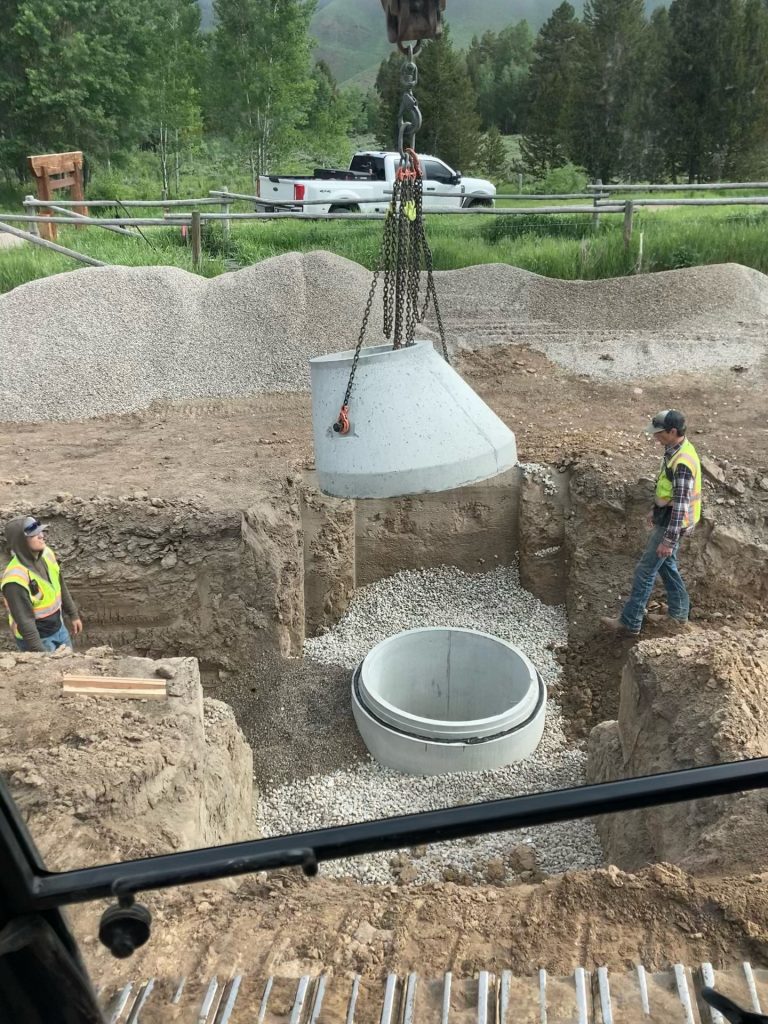
Utility installation is where small mistakes become expensive: improper bedding, incorrect slope, shallow cover, or poor compaction can cause settlement, backups, freezing, or premature failure. For sewer line installation Wyoming and related site prep, the best contractors build to repeatable trench standards.
Trench excavation essentials (what to review before digging)
- Utility locate and marking: call 811 before any excavation and confirm markings on-site. If you’re searching utility marking flags color code, know that colors generally indicate: red (electric), yellow (gas), orange (communications), blue (potable water), green (sewer/storm), purple (reclaimed), white (proposed excavation). Always defer to local guidance and the locate ticket notes.
- Alignment and depth: verify offsets from property lines, easements, and structures; confirm minimum cover for freeze protection.
- Crossings and conflicts: daylight existing lines and plan for sleeves, separation distances, and elevation adjustments.
Sewer and storm performance: slope, bedding, and compaction
- Pipe slope: must match design intent to maintain velocity and reduce sediment. Don’t “eyeball” it—use laser levels or GPS where applicable.
- Bedding and haunching: place and compact correctly so the pipe is supported along the barrel, not just at the bottom of the trench.
- Backfill compaction: compact in lifts appropriate to the material and moisture. Poor compaction is one of the fastest ways to create settlement over trenches—especially under drive lanes and future pavement.
Great Divide Earthworks routinely supports municipal-style expectations, clean trench lines, consistent bedding, and compaction discipline, so private construction projects perform like public infrastructure. If you’re comparing excavation contractor options, ask how they document trench depth, slope checks, and compaction methods.
Mass earthmoving, land clearing, and soil management: build a stable platform before you build anything else
In Western Wyoming, “dirt work” is often a mix of topsoil stripping, rock excavation, unsuitable subgrade remediation, and engineered fill placement. The goal is simple: create a stable, drainable, build-ready platform that won’t move after you pour concrete or pave.
Best-practice sequence for earthwork in Alpine and surrounding areas
- Pre-strip and stockpile topsoil: protect organic-rich soils for final landscape use. Keep piles stable and away from drainage paths.
- Clear and grub: remove roots, stumps, and organics that can decay and cause settlement.
- Subgrade evaluation: proofroll and identify soft/wet areas, spring zones, and variable pockets.
- Undercut and replace (as needed): remove unsuitable soils and replace with structural fill or aggregate per the engineer.
- Build in lifts: place fill in controlled layers with moisture conditioning so compaction is achievable.
Common soil and fill metrics that matter
- Moisture control: dry material won’t compact; overly wet material will pump and rut.
- Lift thickness: thinner lifts compact more reliably, especially with variable on-site material.
- Rock handling: plan for oversize rock separation, hauling, or onsite reuse (where permitted).
If you’re searching for excavating contractors Rock Springs or a professional excavation company closer to Alpine, ask whether they can manage mass earthmoving with a plan for soil segregation, export/import coordination, and finish-grade verification. Great Divide Earthworks focuses on predictable outcomes—grades that drain, pads that stay stable, and materials that are placed with intent.
Drainage, gravel delivery networks, and access roads: the difference between “done” and “durable”
Drainage is a top driver of long-term maintenance problems in mountain builds. When water isn’t guided, it finds the weakest path—across driveways, into basements, under slabs, and through unprotected slopes.
Drainage configurations that perform in Western Wyoming
- Positive surface drainage: shape grades so runoff moves away from structures and toward designed outlets.
- Ditches and swales: stabilize where velocities increase; size for seasonal flows and snowmelt.
- Culverts and crossings: install at proper elevations with adequate cover and end treatments to prevent washouts.
- Subsurface drainage: use when groundwater or perched water threatens subgrade stability.
Aggregate and gravel hauling: what to specify (and why it matters)
Searching gravel hauling near me or aggregate delivery service is common, but the key is ordering the right material for the layer and the use case.
- Base course for roads/driveways: well-graded aggregate that compacts tightly and sheds water
- Surface gravel: sized to lock in and minimize rutting
- Drain rock: clean, open-graded stone for French drains and utility zones where drainage is required
Great Divide Earthworks supports projects with coordinated material sourcing and delivery timing so crews aren’t waiting on trucks—and so the aggregate placed matches the function (road base, trench zone, or drainage layer). This is especially important for alpine excavation paving and access routes that must hold up to construction traffic.
Supporting section: What to ask before hiring an excavation contractor in Alpine
- Will you provide a clear scope: clearing, stripping, mass grading, fine grading, utilities, and restoration?
- How do you verify grades—GPS model, benchmarks, and as-built checks?
- What is your plan for unsuitable soils, groundwater, or rock?
- Can you coordinate with surveyors, engineers, and inspectors?
- Do you have the equipment for steep, tight, or rocky sites common in Western Wyoming?
Supporting section: Red flags that lead to rework and budget blowouts
- Starting excavation without a locate ticket and on-site verification
- No defined plan for spoils, stockpiles, and erosion control
- Backfilling utilities without correct bedding/haunching and lift compaction
- “We’ll fix drainage later” grading that creates ponding near structures
- Unverified imported material that doesn’t compact or doesn’t meet intended use
Supporting section: A quick civil site data checklist (owner-friendly)
| Category | What to document | Why it matters |
|---|---|---|
| Survey control | Benchmarks, control points, datum | Prevents grade drift and rework |
| Earthwork | Strip limits, cut/fill plan, unsuitable zones | Keeps pads stable and predictable |
| Utilities | Depth, slope checks, bedding/backfill method | Reduces settlement, backups, and freezing risk |
| Drainage | Flow paths, culvert elevations, outlets | Protects structures and access |
| Materials | Aggregate type and placement location | Ensures performance of roads and bases |
Frequently Asked Questions
How do I choose between “commercial excavation near me” results that all look the same?
Look for proof of process: grade verification methods (GPS plus checks), utility trench standards, material planning (import/export), and coordination with survey/engineering. Great Divide Earthworks is built around those fundamentals so the finished site performs, not just looks graded.
What does GPS grading change for a project in Alpine?
It typically improves speed and consistency on mass grading and complex slopes—especially when the site has multiple elevations, drainage features, and tight transitions. It does not replace good control, good operators, or verification of benchmarks and critical elevations.
Why is trench backfill and compaction such a big deal on sewer and water lines?
Because settlement happens after the job “looks finished.” Poor compaction can create dips in drive lanes, damage pipe, and lead to long-term maintenance. Proper bedding and lift compaction are core to reliable sewer line installation in Wyoming conditions.
What gravel should I order for a driveway or access road?
It depends on subgrade, drainage, and traffic. Many durable driveways use a compactable base course first, then a surface gravel sized to lock in. If you’re unsure, Great Divide Earthworks can evaluate your subgrade and recommend an aggregate build-up that matches your site and use.
Conclusion: the best Western Wyoming excavation is measurable, inspectable, and built to last
Whether your project is a home site, shop pad, or full commercial build, the winning approach is the same: establish control, move earth with a plan, install utilities to trench standards, and build drainage that survives spring runoff and storms. When those pieces are executed well, everything that follows—concrete, paving, landscaping, and structures—goes smoother.
Call to action: schedule a site consultation with Great Divide Earthworks
Build your commercial or residential property on an unyielding foundation with Western Wyoming’s leading earthwork, site preparation, and utility engineering division. From high-accuracy GPS grading and mass land clearing to complex main sewer utility installations, we deliver the modern machinery and deep field expertise your project demands.
Schedule a comprehensive site consultation with Great Divide Earthworks LLC today at +1 (307) 413-6043.